The Environmental Impact of Same Day Delivery and How to Offset It
The promise of same-day delivery—goods ordered in morning, delivered by evening—represents convenience that modern consumers increasingly expect. However, this expedited service carries significant environmental costs. The logistics industry contributes approximately 8-10% of global greenhouse gas emissions; courier services delivering same-day packages generate disproportionately high carbon footprints per delivery. Understanding these environmental impacts and the strategies to mitigate them is essential for conscientious businesses seeking to balance customer expectations with environmental responsibility.
Understanding the Carbon Footprint of Same-Day Delivery
Same-day delivery's environmental impact stems from fundamental logistics inefficiency. Traditional consolidated overnight delivery enables route optimisation—vehicles carrying full loads of parcels destined for same geographic areas. Same-day requirements fragment this consolidation. A parcel ordered at 2pm must reach a customer's door by 8pm; this tight timeline prevents waiting for additional parcels destined nearby, forcing deployment of partially-loaded vehicles.
Research indicates same-day delivery generates 2-3 times higher carbon emissions per parcel compared to standard overnight delivery. The inefficiency compounds across large volumes—UK consumers placing approximately 6 million e-commerce orders daily, even modest same-day adoption creates substantial carbon impact. Vehicles making emergency deliveries with single parcels represent extreme inefficiency, but even same-day services combining 20-30 parcels generate significantly higher emissions than consolidation-optimized overnight networks.
"A single same-day delivery generates approximately 2.5 kg of CO2 emissions compared to 0.8 kg for standard overnight delivery. Across a single day's orders in the UK, same-day service generates over 10,000 additional tonnes of CO2—equivalent to 2,100 petrol cars driven annually."
Operational Inefficiencies and Empty Miles
Same-day logistics create numerous inefficiencies beyond vehicle utilisation. Urban distribution networks optimised for overnight delivery cluster deliveries geographically, minimizing travel distance. Same-day requirements may dictate serving single customers across broader geographic areas. A driver might deliver a package to a postcode, then travel several miles to another single delivery, creating empty miles between stops.
Vehicle positioning represents another inefficiency. Same-day networks require vehicles distributed throughout service areas, positioned to respond rapidly to orders. This geographic dispersion enables quick response but creates inefficient fleet management. Vehicles may travel circuitous routes seeking density, making unnecessary trips as orders arrive sporadically throughout the day. Consolidated overnight delivery enables strategic positioning of goods at regional hubs, with organized distribution the following morning.
Electric Vehicles and Fleet Decarbonisation
Electric vehicles (EVs) represent the primary mitigation strategy for courier service emissions. Modern electric vans eliminate tailpipe emissions, though grid electricity generation may involve carbon. However, UK grid electricity carbon intensity continues declining as renewable generation increases. Electric vans operating today generate 60-70% lower lifetime emissions than diesel equivalents; as grid decarbonises, this advantage increases. By 2030, electric vehicles will achieve near-zero emissions across their lifetime.
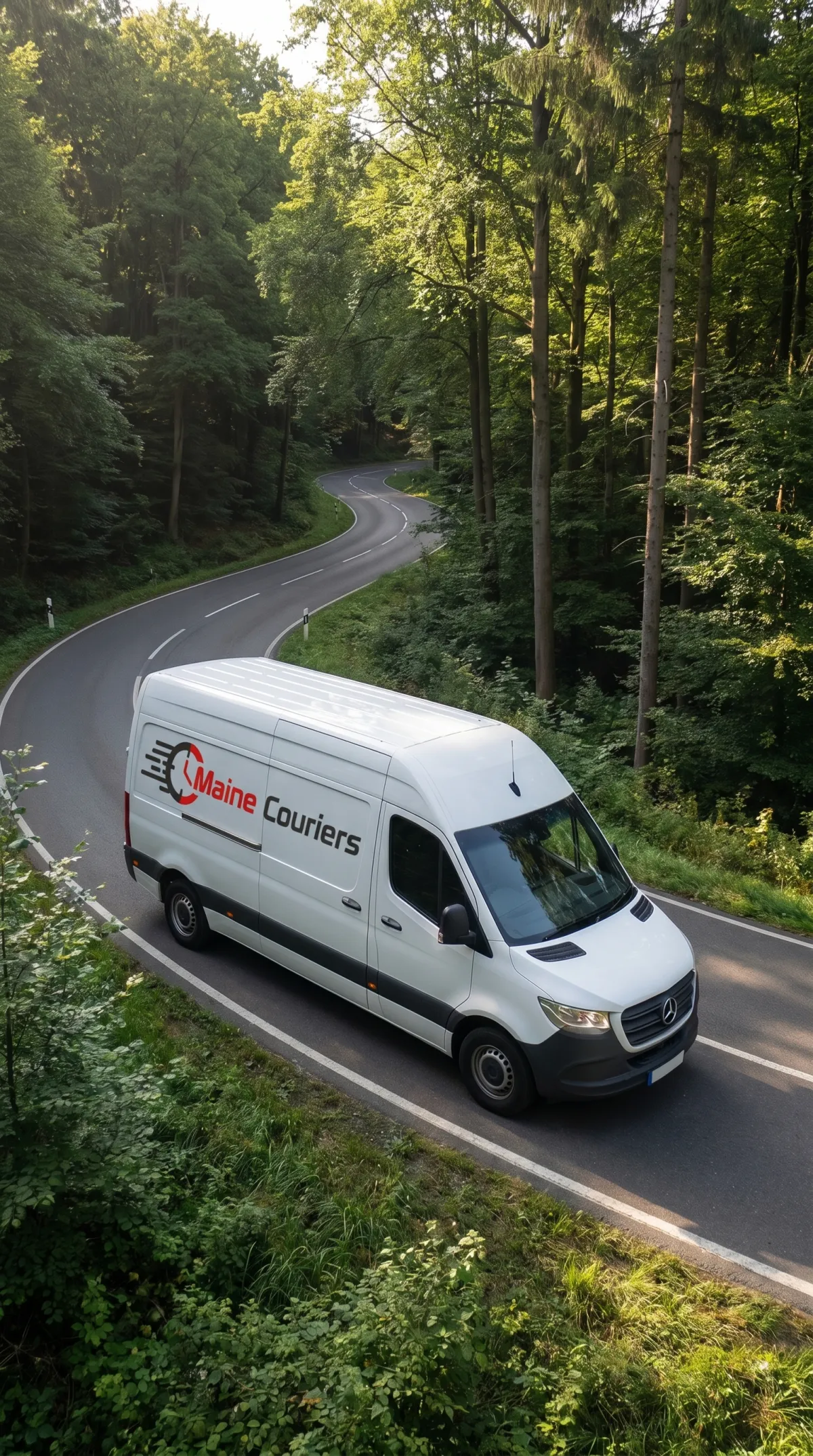
Courier companies transitioning to electric fleets require infrastructure investment—charging stations at depots, en-route charging networks, and vehicle procurement. However, operating costs decline substantially—electricity costs approximately one-third diesel costs. Government incentives including purchase grants and tax benefits reduce acquisition costs. Maine Couriers has deployed over 200 electric vehicles, representing genuine commitment to sustainable operations beyond marketing rhetoric.
Route Optimisation and Consolidation Strategies
Technology enables improved efficiency despite same-day requirements. Advanced routing algorithms consolidate orders by geography, combining multiple same-day deliveries into efficient routes. Machine learning models predict order volumes and distribution, enabling better resource positioning. Geofencing enables customers to specify delivery windows, allowing consolidation of deliveries to neighborhoods during specific hours.
Consolidation strategies extend to partnerships. Some same-day services operate on "marketplace" models where multiple retailers' orders consolidate at urban hubs, then distribute via shared vehicles. This consolidation dramatically reduces per-parcel emissions. Retailers subscribing to such services sacrifice complete control of timing but achieve significant environmental benefits and cost reduction. These hybrid approaches balance customer expectations with sustainability.
Customer Behaviour and Emission Reduction
Consumer choices substantially impact delivery emissions. Customers selecting standard delivery over same-day service enable consolidation, reducing environmental impact by 60-70%. Combining multiple orders into single delivery, accepting flexible delivery windows, or accepting delivery at local pickup points rather than home addresses all reduce emissions significantly. Couriers educating customers about these options and incentivising sustainable choices contribute to broader emissions reduction.
Some retailers offer carbon offset options—customers pay marginal fees enabling carbon sequestration projects or renewable energy investments. Whilst imperfect, carbon offsets provide mechanisms for customers to neutralise their delivery choices' environmental impact. Transparency regarding environmental impact—disclosing emissions at checkout, offering lower-carbon alternatives—enables informed consumer decisions aligning with environmental values.
Industry-Wide Initiatives and Regulations
Environmental consciousness increasingly shapes courier industry standards. Many companies commit to carbon neutrality targets—offsetting remaining emissions beyond operational reductions. Industry organisations establish sustainability standards, tracking and publicly reporting emissions. Regulatory pressure continues increasing, with potential future restrictions on high-emission vehicles in city centres and carbon pricing schemes affecting logistics costs.
Collaboration opportunities exist across competitors. Industry consortiums develop shared sustainability standards, share best practices, and advocate for policies supporting decarbonisation. Some cities fund cargo bike networks and micro-mobility infrastructure benefiting all courier operators. Participating in these collective efforts amplifies impact beyond individual company actions.
Conclusion: Sustainable Delivery is Possible
Same-day delivery's environmental impact is real and significant, but mitigation strategies exist. Electric vehicles, route optimisation, consolidation, customer engagement, and carbon offsetting together create substantially more sustainable same-day delivery. The goal is not eliminating same-day service—customers value convenience—but delivering it sustainably.
Maine Couriers remains committed to providing exceptional same-day service whilst minimising environmental impact. Our electric vehicle fleet, advanced routing systems, and carbon offset programmes demonstrate that convenience and sustainability are not mutually exclusive. Choose a courier partner committed to both service excellence and environmental responsibility.
Choose sustainable same-day delivery with Maine Couriers
We operate an extensive electric vehicle fleet and offset remaining emissions through verified carbon sequestration projects. Fast delivery doesn't mean environmental compromise.
Get a Quote Today