Why Vehicle Size Matters: Choosing the Right Courier Vehicle
Selecting the right vehicle for courier operations is far more complex than simply choosing the largest van available. Vehicle size significantly impacts operational efficiency, cost-effectiveness, environmental footprint, and customer satisfaction. From small parcels requiring pedal-powered delivery to large consignments demanding articulated lorries, matching vehicle capacity to delivery requirements represents one of the most critical decisions courier companies make. Understanding the nuances of vehicle selection helps optimise fleet performance and maximise profitability.
Understanding Payload Capacity and Gross Weight
Vehicle payload capacity—the total weight a vehicle can safely carry—directly determines efficiency and profitability. A delivery van operating below full capacity represents wasted capacity and unnecessary cost. Conversely, overloading a vehicle creates safety risks, accelerates wear, and violates legal requirements.
The distinction between kerb weight (unladen) and gross vehicle weight rating (GVWR) is essential. Couriers must account not only for goods weight but also fuel, driver weight, and vehicle fixtures. A van rated for 1,500 kg payload cannot safely carry goods weighing 1,500 kg when partially fuelled and driven by an 100 kg driver. Accurate payload calculations prevent overloading and ensure regulatory compliance whilst maximising load efficiency.
"Optimising vehicle selection can reduce operating costs by 15-25% through improved load efficiency, reduced fuel consumption, and minimised vehicle wear—direct impacts on profitability."
Cubic Capacity and Density Calculations
Many delivery items are density-limited rather than weight-limited. A van might reach its weight capacity at 60% of available volume, creating unused space. Conversely, bulky lightweight items might fill a van whilst remaining far below weight capacity. Professional couriers calculate cargo density (weight per volume unit) to ensure balanced utilisation of both payload and space.
Small parcels—particularly those from e-commerce retailers—typically exhibit low density, requiring larger vehicles to achieve profitable load weights. Conversely, dense items like machinery or metal components can reach weight limits in relatively small vehicles. Understanding your typical cargo density profile guides vehicle selection, ensuring you deploy vehicles matching your specialisation.
Urban Delivery and Access Restrictions
UK cities increasingly implement access restrictions, particularly ultra-low emission zones (ULEZ) in London, Birmingham, Leeds, and other major cities. More significantly, urban access restrictions often favour smaller vehicles. Narrow city streets, low bridges, and restricted parking make large vans problematic in dense urban centres.
Many courier operations employ a tiered vehicle strategy: large articulated vehicles for inter-city trunk movements consolidate shipments at urban depots, where smaller vans and cargo bikes complete final-mile delivery. This multi-vehicle approach navigates regulatory restrictions, reduces congestion, and often achieves superior delivery performance through increased manoeuvrability and urban access. Cities are increasingly implementing restrictions on large vehicles during peak hours, making this multi-vehicle strategy essential.
Fuel Efficiency and Operating Costs
Vehicle size directly influences fuel consumption and operating costs. Larger vehicles consume more fuel, but operating cost per kilogramme of cargo decreases with vehicle size, provided loads are efficiently utilised. A fully loaded articulated lorry achieves excellent cost-per-kg performance; an underutilised large van incurs disproportionate costs.
Modern telematics systems track fuel consumption and driver behaviour, revealing opportunities for efficiency improvement. Larger vehicles benefit from route consolidation—combining multiple deliveries into single efficient routes. Electric and hybrid vehicles, whilst carrying premium acquisition costs, deliver superior fuel economy and increasingly qualify for regulatory incentives and exemptions from congestion charges.
Vehicle Maintenance and Reliability
Smaller vehicles typically incur lower maintenance costs due to simpler mechanics, smaller engines, and reduced wear. However, economies of scale apply to larger vehicles when properly maintained. A fleet of identical vehicles simplifies parts inventory, driver training, and preventative maintenance scheduling. High-utilisation vehicles require more frequent servicing but benefit from consistent, predictable maintenance costs when properly managed.
Vehicle reliability directly impacts service quality. A breakdown doesn't merely incur repair costs—it disrupts scheduled deliveries, damages customer relationships, and can trigger service penalties. Newer vehicles with extended warranty coverage and lower failure rates often justify premium acquisition costs through improved reliability and reduced downtime. Older vehicles might offer lower acquisition costs but present elevated breakdown risk and operational uncertainty.
Regulatory Compliance and Future Requirements
Vehicle emissions regulations are tightening progressively. Current diesel vehicles already face restrictions in major cities; future regulations will increasingly favour electric and zero-emission vehicles. Early adoption of compliant vehicles avoids future forced replacement cycles and positions companies ahead of regulatory curves.
Driver regulations, including EU working time directives and tachograph requirements, vary by vehicle size. Vehicles exceeding certain thresholds require tachograph equipment and entail driver rest requirements. Understanding these regulations prevents compliance violations and unplanned operational disruptions. Forward-thinking fleet operators anticipate regulatory changes when planning vehicle purchases, selecting vehicles that remain compliant as regulations evolve.
Conclusion: Strategic Vehicle Selection
Vehicle selection transcends simple arithmetic of size versus cost. Successful courier operations match vehicle types to specific roles, load profiles, and delivery geographies. This might mean deploying large vehicles for long-distance trunk movements, medium vans for suburban distribution, and small vehicles or cargo bikes for city-centre delivery. This diversified approach optimises costs, navigates regulatory constraints, and delivers superior customer service.
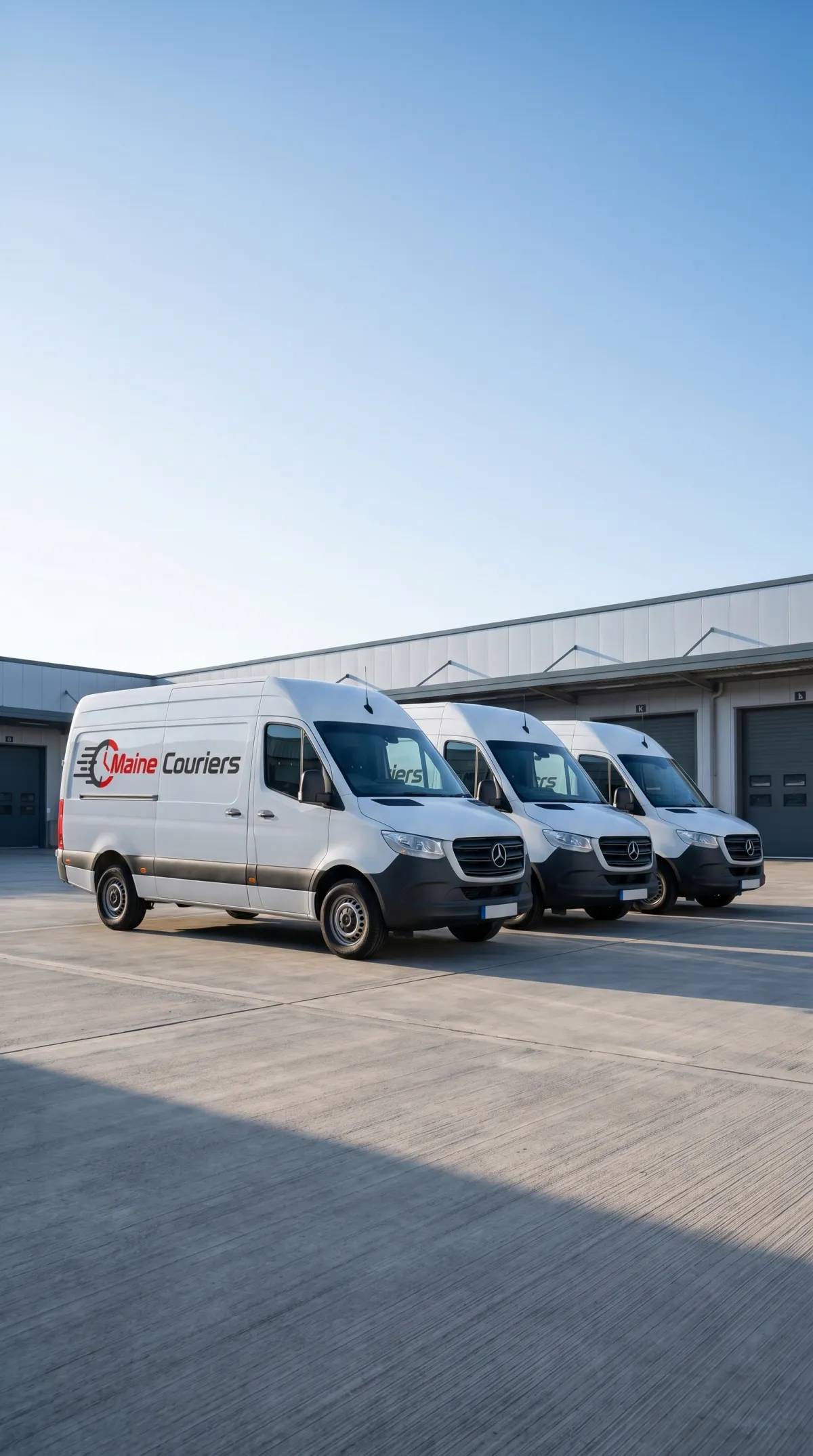
Maine Couriers maintains a strategically diverse fleet, carefully selected to optimise performance for different delivery scenarios. Whether you require large vehicle capacity for consolidated shipments or the manoeuvrability of small vans for dense urban delivery, our fleet selection ensures your goods reach their destination efficiently and reliably.
Let us choose the right vehicle for your delivery needs
Maine Couriers maintains an optimised fleet of vehicles selected for different delivery scenarios. Get the right capacity, compliance, and cost-efficiency for your shipments.
Get a Quote Today