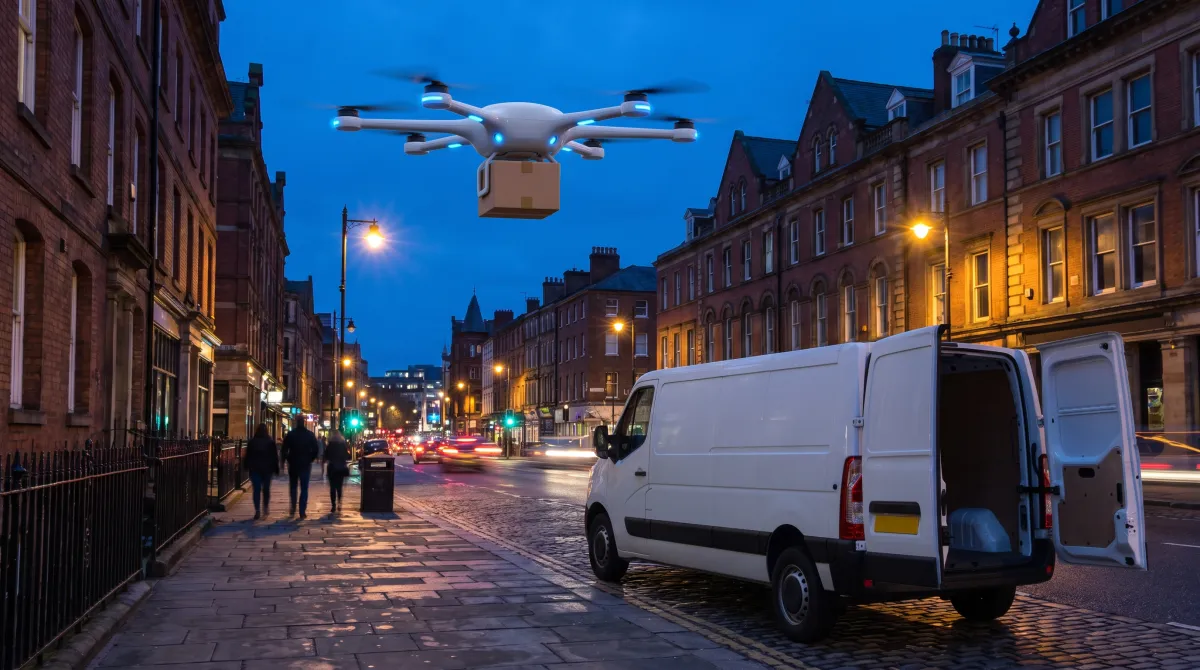
The courier industry stands on the precipice of a technological revolution. Drone delivery systems, once confined to the realm of science fiction, are rapidly becoming a tangible reality in the UK logistics landscape. Major companies like Amazon and Wize are already conducting pilot programmes, whilst regulators like the Civil Aviation Authority are developing frameworks to govern autonomous aerial vehicles. This transformation promises to fundamentally reshape how we think about last-mile delivery, with potential benefits ranging from reduced carbon emissions to faster delivery times in remote areas.
Understanding Drone Delivery Technology
Modern delivery drones are sophisticated machines far removed from consumer hobbyist quadcopters. Commercial delivery drones typically feature advanced GPS systems, autonomous navigation capabilities, and sophisticated sensors designed to avoid obstacles and other aircraft. Current payload capacities range from 2-5 kilograms for most urban delivery models, with emerging systems capable of carrying up to 10 kilograms or more. Battery technology has made significant strides, with modern lithium-polymer cells providing sufficient range for urban deliveries of 5-10 kilometres per charge.
The technology incorporates redundancy systems that ensure safety in all operational conditions. If a primary propeller fails, backup systems engage. If GPS signals are lost, drones can rely on visual inertial odometry to maintain navigation. Real-time telemetry allows operators to monitor fleet health, battery status, and mission progress continuously. This level of technological sophistication explains why initial deployments are focused on controlled environments before expanding to open urban airspace.
Regulatory Landscape and UK Guidelines
The UK Civil Aviation Authority has been remarkably progressive in developing drone regulations. The EASA (European Union Aviation Safety Agency) framework, which the UK continues to follow post-Brexit, establishes clear categories for drone operations. Most delivery scenarios fall into the "specific operations" category, requiring operators to obtain approvals for defined routes and operational parameters.
Current regulations mandate that drones must maintain visual line of sight, though "Extended Visual Line of Sight" (EVLOS) permissions are being granted for specific corridors. Operators must possess appropriate certifications, maintain insurance coverage, and conduct regular safety audits. The CAA's Beyond Visual Line of Sight (BVLOS) programmes are gradually expanding, with several UK companies receiving permissions to operate autonomous delivery routes in designated areas. These regulatory developments are essential for building the framework within which drone courier services can legally operate at scale.
"The UK could become the first European nation to establish a comprehensive drone delivery network if regulatory progression continues at its current pace, positioning British logistics companies as global leaders in aerial logistics technology."
Economic Impact and Cost Efficiency
One of the most compelling advantages of drone delivery is the potential for significant cost reduction. Labour typically comprises 40-50% of last-mile delivery expenses. By automating these deliveries, courier companies could substantially reduce operational costs. A single drone could theoretically complete 50-80 deliveries per day, compared to 100-150 for traditional vehicles but with substantially lower operational costs per delivery.
Initial investment in drone infrastructure is considerable—each delivery drone costs £15,000-50,000, with supporting infrastructure including docking stations, fleet management software, and maintenance facilities adding tens of thousands more. However, the economics improve dramatically at scale. Companies operating fleets of hundreds of drones achieve unit economics that rival or beat traditional courier services whilst simultaneously offering superior speed and flexibility. This is particularly advantageous for e-commerce companies with high delivery volumes.
Environmental and Social Benefits
Environmental advantages represent perhaps the most significant benefit of drone delivery technology. Drones produce zero emissions, eliminating the tailpipe pollution associated with traditional delivery vehicles. A single delivery drone replaces multiple road journeys, reducing overall transportation carbon footprints substantially. In urban areas choked by delivery traffic congestion, drones offer a compelling alternative that bypasses road networks entirely.
Beyond environmental benefits, drones enable delivery to previously underserved areas. Rural communities in Scotland, Wales, and remote English regions could receive deliveries that are economically unviable with traditional vehicles. Islands and areas with limited road access become accessible overnight. For time-sensitive medical deliveries, organs for transplantation, or critical medications, drone delivery could save lives by ensuring rapid transportation independent of traffic or weather constraints.
Challenges and Implementation Roadmap
Significant challenges remain before drone delivery becomes ubiquitous. Weather represents the primary operational constraint—drones cannot operate in high winds, heavy rain, or low visibility conditions. Battery technology, whilst improving, still limits operational range and payload. Infrastructure requirements are substantial, necessitating numerous distribution nodes throughout urban areas. Public acceptance remains uncertain, with noise concerns and safety perceptions potentially slowing adoption.
The implementation roadmap for UK courier services likely involves phased expansion. Initial deployments focus on geographically constrained zones—university campuses, business parks, or suburban delivery corridors. Success in these controlled environments builds operational experience and regulatory confidence. Subsequent phases expand to city centres and connecting routes between distribution nodes. By 2028-2030, most industry experts anticipate regular drone deliveries in major UK cities for packages under 2 kilograms, with continued expansion thereafter.
Conclusion: The Future of UK Courier Services
Drone technology represents a paradigm shift in UK courier services. The convergence of improving technology, progressive regulation, and economic incentives creates an environment where drone delivery transitions from novelty to standard practice. Companies that innovate early and develop expertise will gain substantial competitive advantages. For customers, the benefits manifest as faster deliveries, lower costs, and reduced environmental impact.
The next five years represent a critical period for UK courier companies to position themselves at the forefront of this transformation. Whether through developing internal drone capabilities or partnering with emerging aerial logistics providers, forward-thinking courier services are already preparing for an airborne future. The question is no longer whether drones will deliver packages in the UK, but rather how quickly the industry can safely and responsibly scale this revolutionary technology.
Need Reliable Courier Services Today?
Whilst we await the drone revolution, Maine Couriers delivers packages across the UK with proven reliability and expertise. Same-day, overnight, and international services available.
Get a Quote